Impossible Modernism: T. S. Eliot, Walter Benjamin, and the Critique of Historical Reason by Robert S. Lehman
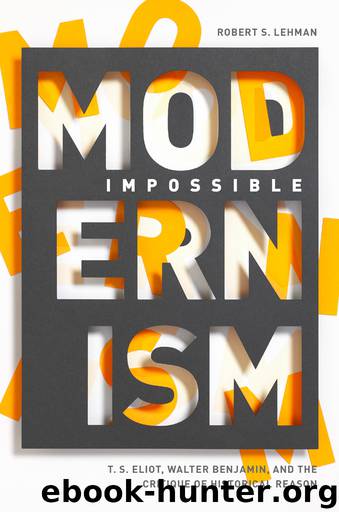
Author:Robert S. Lehman [Lehman, Robert S.]
Language: eng
Format: epub
Publisher: Stanford University Press
Published: 2016-09-25T16:00:00+00:00
PART 2
KILLING TIME, WALTER BENJAMIN
CHAPTER 4
ORDER
IN A LETTER to his friend Gerhard (later, Gershom) Scholem dated 1 February 1918, Walter Benjamin describes a shift in his plans. Having intended to write his dissertation on Immanuel Kant’s philosophy of history and, more particularly, on the status within that philosophy of the “infinite task” (C 103–104), Benjamin expresses to Scholem his frustration at having discovered that “it is virtually impossible to gain any access to the philosophy of history using Kant’s historical writings as a point of departure” (116). He concludes his letter by pointing to the “Idea for a Universal History with a Cosmopolitan Aim” (1784) as evidence of Kant’s failure, pausing for a jab at his former teacher at the University of Freiburg, the neo-Kantian Heinrich Rickert—Rickert’s method, Benjamin notes, is “modern in the worst possible sense of the word”—and wishing Scholem “all the best from me and my wife.” Two months later, another letter to Scholem makes it clear that Benjamin’s earlier plans to write on Kant and history are very much a thing of the past. He outlines for his friend a new dissertation topic. He will focus on the early German romantic conception of art criticism, will seek to show that “only since romanticism has the following view become predominant: that a work of art in and of itself, and without reference to theory or morality, can be understood in contemplation alone” (119). At least initially, Benjamin reserves for Kant a place in this new project, for, he notes, “Kant’s aesthetics constitute the underlying premise of romantic art criticism.” Soon enough, though, Benjamin accepts that there may be no place for Kant in his dissertation; indeed, he accepts that the romantics’ “historically and fundamentally important congruence [Koinzidenz] with Kant . . . may prove impossible to demonstrate in ‘dissertationlike’ format” (125). This would, apparently, be the case: Benjamin’s dissertation, The Concept of Art Criticism in German Romanticism (Der Begriff der Kunstkritik in der deutschen Romantik), successfully defended at the University of Bern in June 1919, contains scant reference to Kant, focusing instead on the importance to Frühromantik of the subjective idealism of J. G. Fichte.1 Kant, it would seem, has given way to the post-Kantians (to Fichte, Novalis, and the Schlegels, if not yet to Hegel or Marx).
Benjamin’s decision to abandon Kant’s philosophy of history as a dissertation topic has not enjoyed the same attention paid to other philosophical reversals, to Martin Heidegger’s Kehre, for example, or to the long crisis that divided Ludwig Wittgenstein’s career between the Tractatus and the Philosophical Investigations.2 Perhaps the reason for this inattention is simply that Benjamin did not yet have in 1918 a stable position to disavow or a fully developed philosophical program to which his later writings could act as a counterpoint. Or perhaps the reason is that Benjamin’s decision to move on from Kant now seems to us so natural, so necessary, and thus not so much a reversal as an advance. Benjamin’s movement from Kant to post-Kantian
Download
This site does not store any files on its server. We only index and link to content provided by other sites. Please contact the content providers to delete copyright contents if any and email us, we'll remove relevant links or contents immediately.
Still Me by Jojo Moyes(11473)
On the Yard (New York Review Books Classics) by Braly Malcolm(5574)
A Year in the Merde by Stephen Clarke(5522)
Eleanor Oliphant Is Completely Fine by Gail Honeyman(5372)
The Bookshop by Penelope Fitzgerald(3947)
How Music Works by David Byrne(3377)
Surprise Me by Kinsella Sophie(3156)
Pharaoh by Wilbur Smith(3074)
Why I Write by George Orwell(3057)
Churchill by Paul Johnson(2712)
A Column of Fire by Ken Follett(2670)
The Songlines by Bruce Chatwin(2635)
The Beach by Alex Garland(2598)
Aubrey–Maturin 02 - [1803-04] - Post Captain by Patrick O'Brian(2345)
Heartless by Mary Balogh(2297)
Elizabeth by Philippa Jones(2255)
Hitler by Ian Kershaw(2250)
Life of Elizabeth I by Alison Weir(2146)
Harry Potter and the Cursed Child by J. K. Rowling & John Tiffany & Jack Thorne(2132)
